

The Ultimate Guide to Paper Mailers for DTC Apparel Brands
Learn how to balance sustainability, cost, and performance when selecting paper mailer options.
Table of Contents
Consumer demand for sustainable packaging is driving the fast adoption of paper mailers.
For this reason, paper mailers have evolved into a powerful medium that directly impacts:
- Brand equity
- Operational efficiency
- Customer loyalty
- Sustainability
If your brand is looking to make the transition, you need to build an efficient strategy for procurement.
This guide provides you with the strategic frameworks to ensure your paper mailers become a cornerstone of your success.
Key Takeaways
Influencing brand perception: A paper mailer forms a key part of the unboxing experience and affects how customers judge your brand, including product quality and level of care.
Printing method affects cost: Each printing method uses a different setup process and pricing model, which changes your total spend and how easily you can test or update designs.
Sustainability requires strategic choices: A move to paper mailers only supports sustainability when you select materials, coatings, and finishes that meet recycling standards and can be backed by credible certifications.
Mailer selection shapes operations: The mailer you choose can change packing speed, the rate of shipping damage, freight costs, and how easily your fulfillment process scales.
Enhancing Your Brand Experience With Paper Mailers
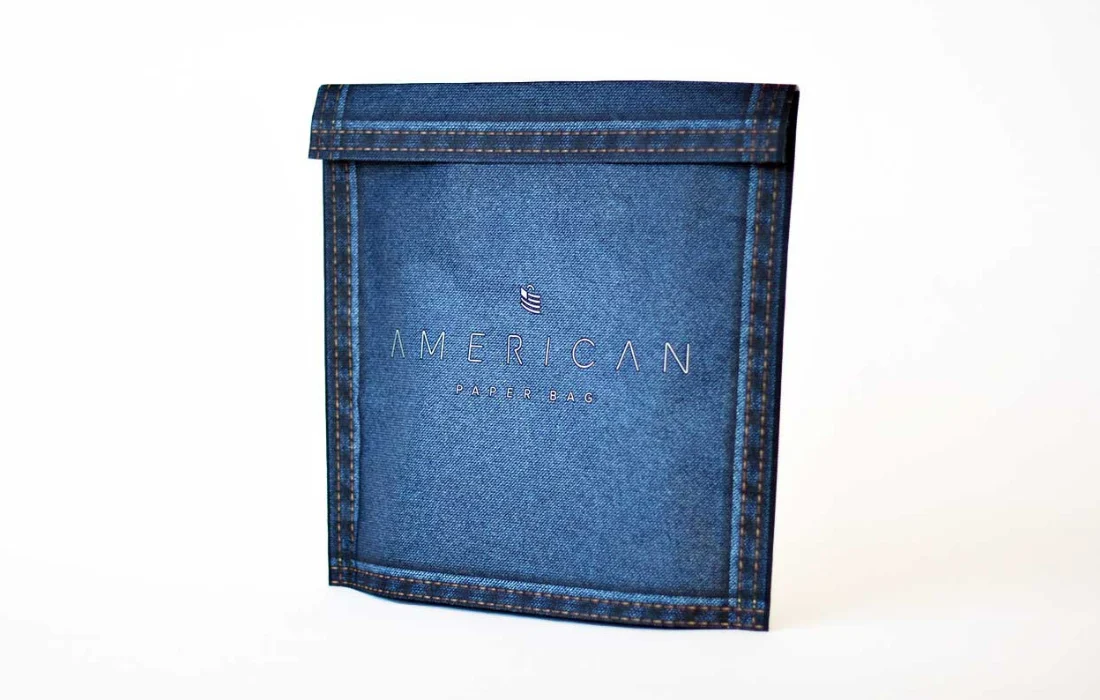
The paper mailer offers a unique visual canvas to transform a routine delivery into a memorable brand experience.
The unboxing moment is a critical extension of your brand’s narrative.
Moving beyond a simple logo to a multi-sensory experience can generate more ROI in customer loyalty and social media engagement.
This requires strategic customizations, which include:
- Printing & Visuals
- Tactile Finishes
- Functional Design
Printing & Visuals
The choice of printing technology dictates the visual quality, cost-efficiency, and potential for personalization.
Flexography
This is the established workhorse for high-volume production runs.
Flexography is highly cost-effective at scale, with minimum order quantities (MOQs) often starting at 25,000 units or more.
It offers extensive color capabilities, including:
- Printing up to 10 colors
- Pantone (PMS) color matching
- Application of varnishes for a refined finish
Offset Lithography
Widely regarded as the gold standard for print quality, offset printing delivers exceptional fidelity, intricate detail, and vibrant color reproduction.
This method is ideal for luxury apparel brands seeking to convey the highest quality through their ecommerce packaging.
It allows for the seamless integration of specialty post-print finishes to create a truly high-end look.
Digital Printing
This technology is the key to agility, personalization, and speed-to-market.
Digital printing enables cost-effective short runs, with MOQs as low as 250 to 500 units.
Its most powerful capability is variable data printing, which allows for true one-to-one personalization.
Brands can print various elements on each mailer to create a deeply personal connection, including:
- The customer’s name
- Loyalty program status
- Promotional QR codes
- Targeted messaging
While the per-unit cost may be higher than flexography at massive volumes, the ability to test new designs, run limited-edition collaborations, and personalize at scale offers unparalleled marketing flexibility.
The table below provides an overview of each printing method based on specific business objectives.
Printing Method Comparison
| Printing Method | Ideal Run Size (MOQ) | Cost Profile | Print Quality | Color Capability | Variable Data | Key Advantage |
|---|---|---|---|---|---|---|
| Flexography | High Volume (25,000+) | Low setup cost, very low per-unit cost at scale | High | Excellent (up to 10 colors, PMS matching) | No | Cost-efficiency for mass production |
| Offset Lithography | Medium to High Volume | Moderate setup cost, moderate per-unit cost | Exceptional | Superior (precise PMS matching, specialty inks) | No | Unmatched print quality and premium finish options |
| Digital Printing | Low to Medium Volume (250+) | No setup cost, higher per-unit cost | Very High | Excellent (CMYK process, wide gamut) | Yes | Agility, speed-to-market, and hyper-personalization |
The Impact of Tactile Finishes
The psychological impact of touch is a powerful, yet not often used, tool in branding.
Research has shown that engaging a consumer’s sense of touch can elevate the perceived value of your product and positively influence purchasing decisions.
Soft-Touch Coating
Applying a soft-touch coating creates a luxurious, velvety, and matte texture that feels premium and resists fingerprints.
This tactile sensation instantly communicates sophistication.
It can also slightly mute darker ink colors, an effect that can be leveraged to create an elegant aesthetic.
Embossing & Debossing
These techniques create a three-dimensional, raised (emboss) or recessed (deboss) effect on logos, monograms, or patterns.
This adds a physical dimension to your mailer’s design that encourages physical interaction and leaves a lasting impression.
Textured Papers
The choice of the paper substrate itself can be a branding statement.
Paper materials that have an inherent texture mimicking linen, felt, or vellum provide a rich tactile quality.
This communicates a sense of tradition, luxury, and attention to detail before a single drop of ink is applied.
Structural Design
Functional design elements can turn a potentially frustrating process into a seamless and satisfying one.
Easy-Open Tear Strips
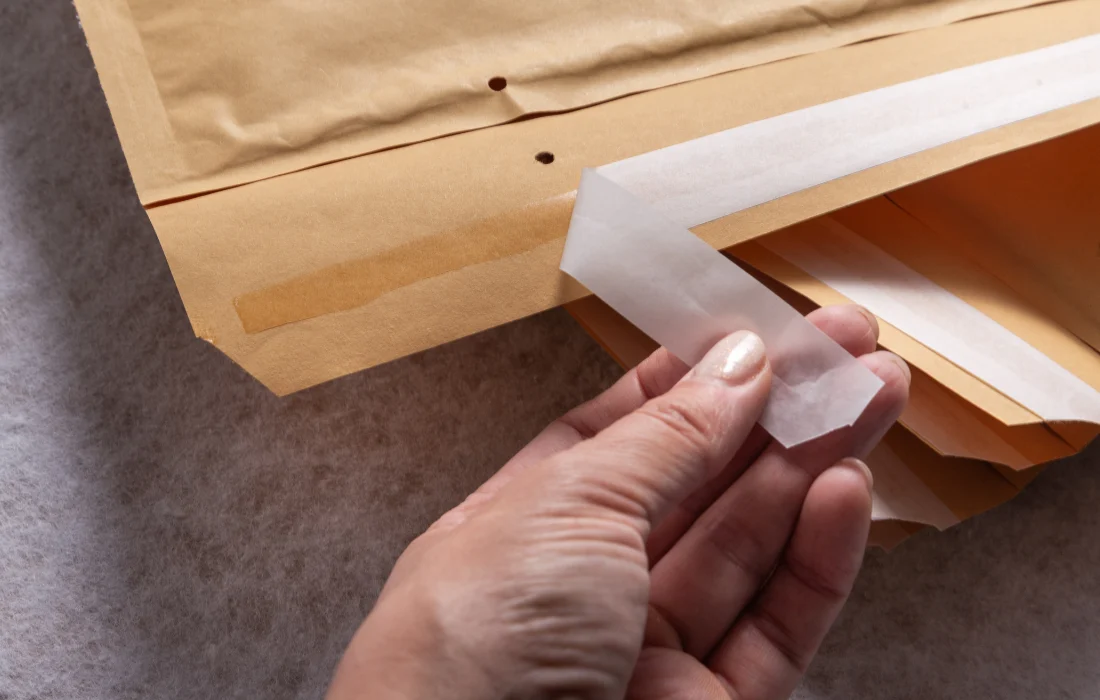
Tear strips provide an easy opening mechanism that eliminates the need for scissors or knives.
This element reduces the risk of the customer accidentally damaging the apparel inside.
A well-designed tear strip that rips cleanly is a subtle but powerful signal of a brand’s focus on the customer experience.
Dual Adhesive Strips
A mailer featuring a second self-seal adhesive strip simplifies the returns process and reduces friction.
This positions your brand as customer-centric, while also encouraging the reuse of the original mailer—a layer of practical sustainability.
Improving Product Protection With Paper Mailers
While the branding potential of paper mailers is significant, their primary function remains the secure delivery of goods.
Ensuring product integrity throughout your supply chain is a non-negotiable aspect of risk management.
This requires moving beyond subjective assessments of “sturdiness” to a quantitative evaluation of key metrics.
Paper Performance Metrics
It is essential to understand and specify the technical attributes of a paper mailer to packaging suppliers.
This ensures optimal performance without over-engineering or unnecessary cost.
You want your mailers to match the product it protects precisely.
This will move your brand from a reactive model of dealing with damaged goods to a proactive model of risk mitigation.
Paperboard Thickness and Basis Weight
The thickness of paperboard is measured in points (pt), where one point is equal to one-thousandth of an inch.
A standard mailer might use 15 pt paperboard, while a more robust version for heavier items like outerwear could use 18 pt paperboard.
The guiding principle is that higher-value, heavier, or bulkier items necessitate a thicker material to prevent creasing and tearing under the stresses of transit.
However, there is a crucial trade-off:
Excessively thick paper can be more difficult for fulfillment centers to handle efficiently.
The selection of paperboard thickness must therefore balance protection with operational ergonomics.
Burst Strength (Mullen Test)
This is the most critical metric for preventing catastrophic package failure.
Burst strength, often determined by the Mullen Test, measures the material’s resistance to rupture when subjected to increasing hydraulic pressure.
It is a direct indicator of how well your paper mailers will contain their contents when stressed from the inside out.
Demanding that suppliers provide mailers tested against recognized international standards provides a standardized benchmark for quality control.
These include:
Tear Resistance (Elmendorf Test)
Tear resistance measures a material’s ability to withstand the propagation of a tear once it has been initiated.
Paper mailers are frequently nicked or snagged by sorting machinery or sharp corners.
High tear resistance ensures that these minor damages do not escalate into major rips that could expose the product.
Structural Reinforcements
Beyond the material properties, the physical construction of your mailers plays a vital role in their protective capabilities.
Gussets
Gussets are expandable folds on the sides or bottom of a mailer.
For bulky apparel like hoodies, sweaters, or multi-item orders, gussets allow the mailer to conform to the product’s shape without placing undue stress on the seams and flat surfaces.
This distribution of stress prevents the mailer from bursting at the seams, a common failure point for overstuffed mailers.
Seam and Flap Construction
The method of sealing and constructing the mailer’s edges is fundamental to its strength.
Advanced mailers may feature an elegant side seam construction, which offers a more polished aesthetic and can be stronger than a traditional center seam.
For padded mailers, a double-fold and double-glued bottom flap provides an increase in protection against bursting under load.
Optimizing Operations With Paper Mailers
The financial and logistical impact of ecommerce packaging choices extends far beyond the per-unit material cost.
Choosing paper mailers over a traditional corrugated box can unlock efficiencies in shipping costs, warehousing, and labor productivity.
For operations shipping thousands of orders per day, these gains add to your brand’s profitability.
Reducing Shipping Costs
The greatest advantage of paper mailers lies in their ability to mitigate the impact of dimensional (DIM) weight pricing.
All major carriers, including UPS, FedEx, and USPS, calculate shipping costs based on a metric known as billable weight.
The billable weight is the greater of the package’s actual weight or its dimensional weight.
Dimensional weight is a calculation of a package’s density, determined by the formula:
Dimensional Weight = Length x Width x Height / DIM Divisor
The DIM Divisor is a carrier-specific number that represents the volume allowed per pound.
Example: 139 for domestic ground shipments in the US
This pricing model penalizes shippers of large, lightweight items.
For apparel, this is critical.
A 2 lb winter coat shipped in a 12 x 10 x 6 inch box would have a dimensional weight of (12 * 10 * 6) / 139 = 5.18 lbs.
The brand would be billed for shipping 6 lbs, not 2 lbs, effectively tripling the cost.
How Paper Mailers Reduce Shipping Costs
Paper mailers fundamentally disrupt this equation.
By being flexible and form-fitting, they dramatically reduce the L x W x H volume of the package.
The same 2 lb coat in a 15×12 inch mailer might only be 2 inches thick when packed.
Its volume is drastically smaller, ensuring its dimensional weight is less than its actual weight.
Consequently, the brand is billed for the 2 lb actual weight, realizing a shipping cost savings of over 60% on that single order.
Optimizing for DIM weight by using paper mailers is one of the most powerful levers for reducing transportation spend.
Warehouse and Labor Efficiency Gains
The physical characteristics of paper mailers drive further efficiencies within fulfillment centers.
Storage Density
Mailers are stored flat in compact cases, whereas corrugated boxes consume a larger warehouse footprint.
This space optimization is critical in high-cost real estate markets.
It also allows for more efficient use of shelving and floor space.
Labor Productivity
The fulfillment process for a paper mailer is faster and requires less labor than for a box.
A packer using a self-sealing mailer follows a simple three-step process:
- Insert product
- Peel liner
- Seal flap
In contrast, packing a box involves more steps:
- Assemble box
- Tape bottom
- Insert product
- Add void fill material
- Tape top
The streamlined workflow of packing paper mailers allows a single packer to process more orders per hour.
This speeds up fulfillment, cuts labor costs, and helps manage peak season rushes.
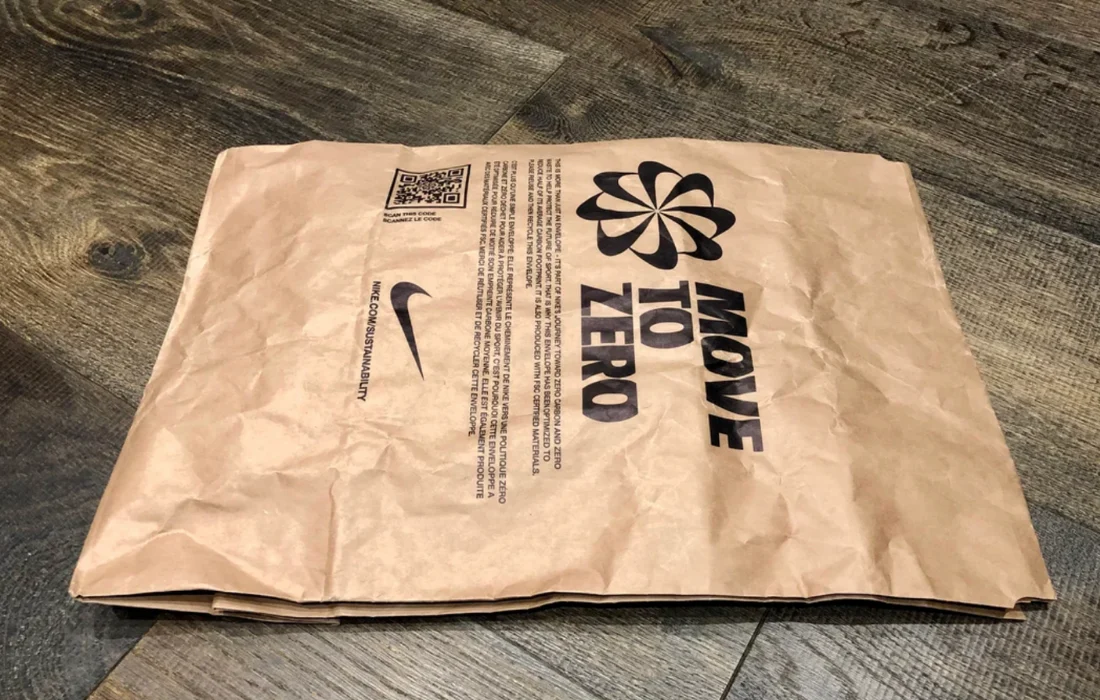
Enhancing Sustainability With Paper Mailers
For today’s discerning consumer, sustainability is a core expectation.
And your brand’s ecommerce packaging is its most visible environmental statement.
Making authentic sustainability claims requires a level of diligence that goes far beyond simply choosing paper over plastic.
You must navigate a complex ecosystem to ensure your ecommerce packaging choices are genuinely circular and not just “greenwashed.”
Consider:
- Certifications
- Material definitions
- Chemical compositions
Forest Stewardship Council (FSC) Certification
The Forest Stewardship Council (FSC) is the gold standard for verifying that paper products come from responsibly managed forests.
Understanding the different FSC labels is crucial for communicating your brand’s sourcing strategy.
- FSC 100% | This label guarantees that 100% of the wood fiber in the product originates from FSC-certified forests.
- FSC Mix | This label indicates the product is made from a mixture of materials from FSC-certified forests, recycled materials, and/or FSC-controlled wood.
FSC Recycled | This label certifies that the product is made from 100% recycled fiber.
Post-Consumer vs. Pre-Consumer Waste
Within the “recycled” category, a further distinction provides a deeper measure of a product’s circularity.
This is a key detail that eco-conscious consumers recognize and value.
Post-Consumer Waste (PCW)
This is packaging material that has served its intended purpose and has been recovered from consumers or businesses, thereby being diverted from a landfill.
A high PCW content is the hallmark of a truly circular product, as it “closes the loop” by turning consumer waste into a new product.
Pre-Consumer Waste (PIW)
Also known as post-industrial waste, this is material that was diverted from the waste stream during a manufacturing process.
Examples include paper trimmings from a printing press or sawdust from a lumber mill.
While recycling PIW prevents manufacturing waste from being landfilled, it does not involve reclaiming materials from the end consumer.
High PCW content is generally considered a better indicator of a product’s circularity.
The Hidden Saboteurs of Recyclability: Inks and Adhesives
A paper mailer’s actual environmental impact is determined by its ability to be recycled back into usable paper pulp.
But if your mailers are contaminated, they cannot be recycled.
Inks
The chemistry of the ink used for branding can affect the recycling process.
Petroleum-based inks and heavy metal pigments can be difficult to remove during the de-inking phase of pulping.
This contaminates the entire batch of recycled fiber and leads to discoloration or rejection.
To ensure true recyclability, your brand should specify the use of sustainable inks.
Leading options include:
- Soy-based
- Vegetable-based Inks
- Water-based Inks
- Algae Ink
Furthermore, ensuring inks comply with standards like the EuPIA Exclusion Policy guarantees they are free of hazardous raw materials.
Adhesives
The adhesive used in the self-seal strip is one of the most common contaminants in paper recycling.
Standard pressure-sensitive adhesives do not break down in the pulping process and instead form small globules known as “stickies.”
The solution is to specify the use of “repulpable” adhesives explicitly.
These are engineered to dissolve wholly and safely during the pulping process without leaving behind any contaminating residue.
The Different Types of Paper Mailers
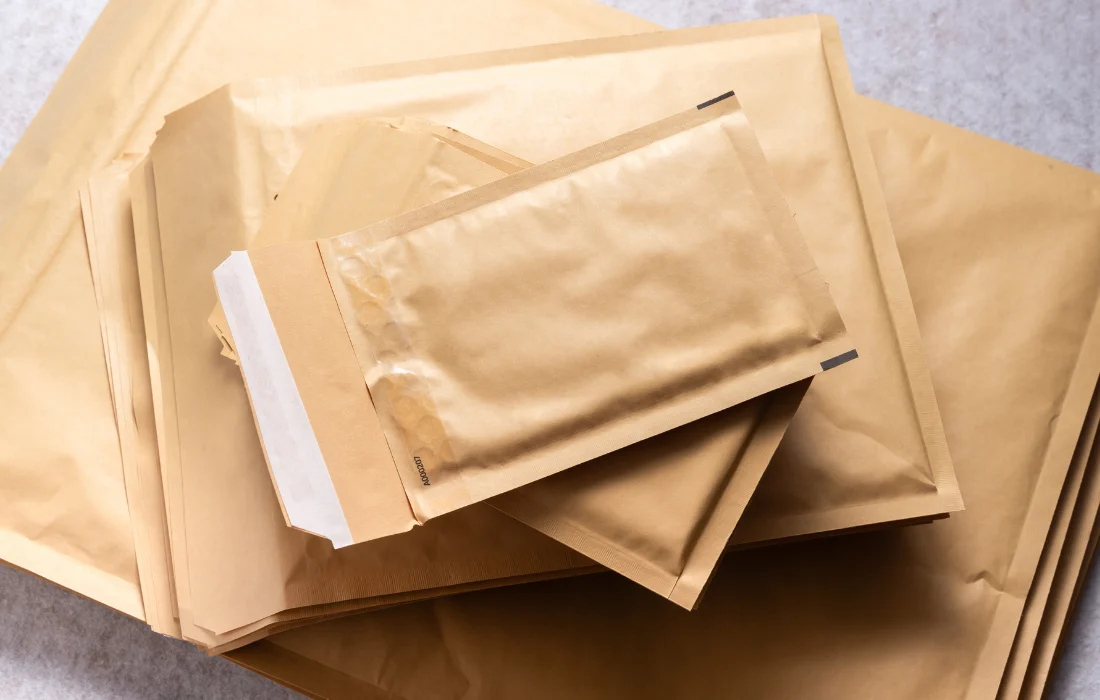
The market offers a diverse range of paper mailer types, each engineered with distinct properties.
Moving beyond a one-size-fits-all approach to a tailored selection allows your brand to optimize for protection, cost, and customer experience.
Economy Kraft Mailers
These are the entry points for brands transitioning from poly mailers.
Typically constructed from 100% recycled kraft paper with a lighter basis weight, they are the most cost-effective paper option.
They are best suited for shipping lightweight, durable, and non-fragile apparel such as t-shirts, leggings, socks, and baby clothes.
While offering basic protection and sustainability, their lower tear and puncture resistance make them less ideal for heavy or bulky items.
They are the optimal choice for value-driven brands where the primary goal is a low-cost shipment.
Water-Resistant Paper Mailers
This mid-tier category represents a step up in durability and functionality.
These mailers are made from a heavier paper stock that often uses a higher percentage of stronger fibers to enhance tear and puncture resistance.
Their key feature is a higher degree of water resistance, achieved through specialized paper treatments or coatings.
This feature makes them an ideal alternative to poly mailers for all-weather shipping.
Premium Paper Mailers
These paper mailers are designed to deliver a premium unboxing experience.
They are constructed from thick paperboard, which provides a flat presentation that resists bending and creasing in transit.
Often featuring structural upgrades, they convey a sense of quality and luxury.
These paper mailers are the preferred choice for high-end apparel, delicate fabrics, and outerwear, where the packaging is an integral part of the product’s perceived value.
Protective Paper Mailers
For apparel with fragile elements, cushioned paper mailers are necessary.
These sustainable options replace plastic bubble wrap with paper-based alternatives:
Macerated Paper Padded Mailers
These feature a cushioning layer made from shredded newspaper sandwiched between two sheets of kraft paper.
Honeycomb Mailers
These innovative mailers use a die-cut paper structure that expands into a protective honeycomb lattice.
Rigid Mailers
While primarily designed for shipping bend-sensitive items like art prints and documents, rigid mailers have a niche application in apparel.
Constructed from extra-thick paperboard, they are engineered to be unbendable.
They are an excellent choice for shipping delicate items that must arrive in pristine condition, such as luxury silk scarves, ties, or fine lingerie.
The following matrix provides a clear framework to guide your mailer selection process.
Paper Mailers Selection Guide
| Mailer Type | Key Material Spec | Protection Level | Cost Index | Brand Positioning | Ideal Apparel Application |
|---|---|---|---|---|---|
| Economy Kraft | 100% Recycled 10 pt Paper | Low–Medium | $ | Value / Eco-Conscious | T-shirts, leggings, socks, lightweight items |
| Performance | 100% Recycled 11 pt Paper (Water-Resistant) | High | $$ | Performance / All-Weather | All apparel, including sweaters, jeans, and multi-item orders |
| Premium Apparel | 100% Recycled 15–18 pt Paperboard | High | $$$ | Premium / Luxury | High-value garments, outerwear, gift orders, subscription boxes |
| Cushioned (Paper) | Kraft with Macerated Paper or Honeycomb | Very High | $$$ | Protective / Specialized | Apparel with fragile buttons, beads, or accessories |
| Rigid Mailer | 100% Recycled 28–36 pt Paperboard | Maximum (Anti-Bend) | $$$$ | Niche / Ultra-Protective | Luxury silk scarves, ties, and items requiring perfect flatness |
Transition to Paper Mailers With Expert Guidance
To transform your ecommerce packaging from a cost center into a competitive edge, you are going to need a strategic partner.
With over 50 years of industry leadership, we provide an end-to-end, consultative approach that aligns packaging solutions with core business goals.
Our proven expertise is demonstrated through our successful partnerships with premier apparel brands, including Filson, Draper James, Girlfriend Collective, and Vineyard Vines.
Let us help you source premium paper mailers that enhance your brand, optimize your operations, and solidify your commitment to sustainability.