

Reduce Packaging Waste: A Strategic Guide for Omnichannel Retailers
Learn how to develop packaging that keeps costs down and keeps you compliant with new regulations.

Table of Contents
Retailers selling through multiple channels must overhaul their packaging strategy to succeed financially and operationally.
The rise of online shopping and quick delivery has made the problem of excessive packaging worse, which is bad for the planet and a company’s brand image.
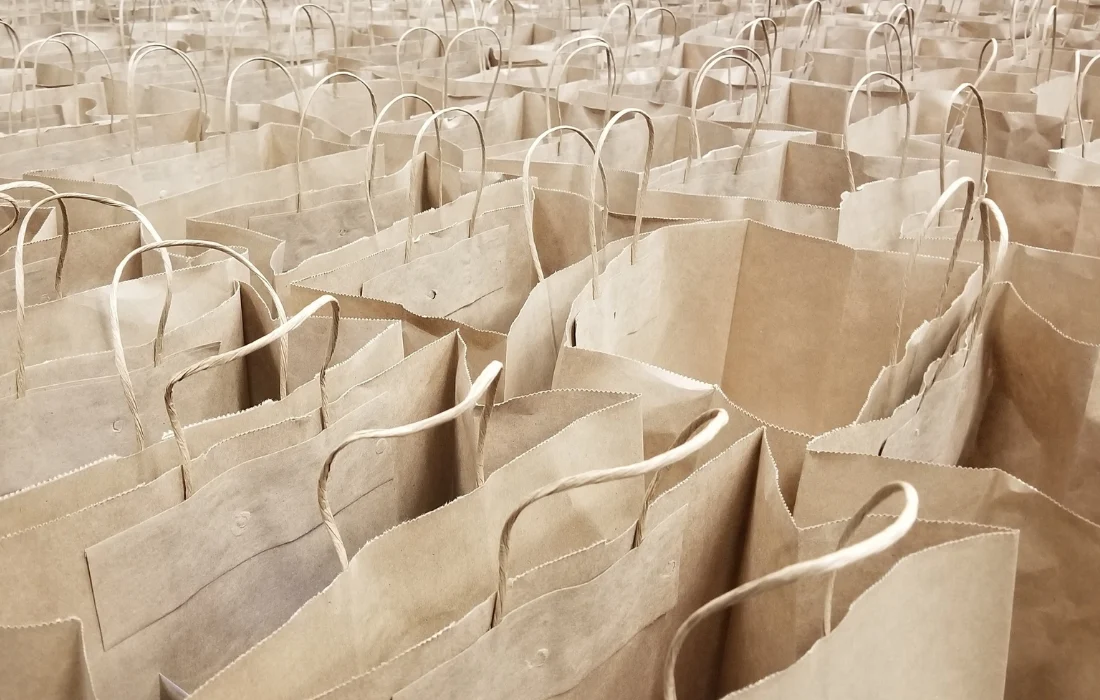
What would be a reason why we need to reduce packaging waste in shopping bags that we could insert here?
Instead of viewing packaging reduction as just another expense, your brand should see it as a smart move that…
- Helps you avoid regulations
- Streamline your operations
- Enhance your brand’s image
This guide explains how to reduce your packaging waste with strategies from our experts.
Key Takeaways
High-PCR content mandate: All single-use mailers and paper bags must use materials that meet strict PCR content thresholds of 50% minimum to comply with upcoming regulations.
EPR cost advantage: Investment in sustainable materials is financially supported by the reduced regulatory costs under EPR compared to using penalized virgin materials.
Stores as return hubs: Physical store locations must be strategically utilized as critical reverse logistics hubs for consumer take-back and reuse programs.
Omnichannel return activation: Leveraging the omnichannel footprint to drive consumer participation in returning reusable poly mailers.
Monomaterial packaging design: Packaging must be designed using a single type of material to be fully curbside recyclable.
Film-to-paper transition: Replace problematic inner packaging films with 100% recycled paper alternatives and adopt plastic film take-back programs for mailers.

The Cost of Packaging: Why Material Choices Matter Now
New government rules, like Extended Producer Responsibility (EPR), require companies to pay fees based on the type of packaging they use and how recyclable it is.
This creates a strong financial incentive for your brand to switch to high-quality recycled materials.
EPR Legislation
This financial push is shown by the shift in cost under EPR programs, which are quickly being adopted across US states.
EPR legislation shifts the financial responsibility for packaging waste management from local governments to the brands that use the packaging.
This means your brand must pay fees based on the type and volume of packaging it puts on the market.
Because non-recyclable or virgin materials usually incur higher “eco-modulation” fees, the cheapest option becomes the one that uses the most recycled content and reduces regulatory fees.
When companies cut wasted packaging material, they also lower the cost of buying materials and decrease the weight of shipments, leading to shipping savings.
The Financial Risk
Here is a look at a hypothetical model of the financial risk of not using circular materials.
| Resource | What it Provides |
|---|---|
| United States Trade Representative (USTR) | Official tariff-rate schedules, ongoing investigations, exclusion or reinstatement notices. |
| U.S. International Trade Commission (USITC) | Official classification of goods and duty rates. Search by HTS chapter/product. |
| U.S. Customs and Border Protection (CBP) | Notices, trade remedy bulletins, Customs rulings, CSMS (Cargo Systems Messaging Service) announcements. |
| World Trade Organization (WTO) | “Bound” rates, MFN applied rates by country and product line; comparative and historical data. |
| U.S. ITC DataWeb | Import/export volumes, historical applied tariffs, and duty distributions by tariff line. |

Designing Mailers and Shopping Bags for Use and Reuse
A smart strategy focuses on making the mailers and paper shopping bags as useful and sustainable as possible for the customer.
The Focus on Secondary Packaging and Overpackaging
For online sales, the main problem is Secondary Packaging—the outer mailer or bag—which often leads to overpackaging.
Products designed for stores frequently need an extra layer of protective material to survive direct-to-customer (D2C) shipping.
Examples:
- Secondary box
- Void fill
- Poly mailer
The Solution: Use highly circular, lightweight mailer materials, like recycled paper or poly, and design them efficiently.
Making Returns Easier with Mailer Design
When customers buy online and return in stores, your packaging must handle this flexible process.
Mailer design can improve this.
For instance, using dual-seal mailers allows a customer to open a package with a tear strip.
Then, use the second sticky strip to return or exchange the item.
This simplifies the return path and provides clarity to the shopper.
Adopting the principles of Frustration-Free Packaging (FFP) for mailers and shopping bags is key.
FFP requires packaging to be easy to open and made of 100% curbside recyclable materials.
How to Make All Mailers and Shopping Bags Reusable
Scaling reusable packaging is crucial.
Your brand must move beyond the simple reduce/recycle model.
Reusable packaging is designed to be returned, refilled, and used many times.
For mailers, this requires establishing systems for cleaning, return, and recirculation.
Modeling Reusable Poly Mailers for Online Shopping
Reusable mailers are typically made from durable materials, like textile-based plastic (such as RPET) or natural fibers, designed to withstand 20 to 100 or more cycles.
Choose one of these two models for managing reusable D2C poly mailers:
- Brand Managed (Internal Loop): The retailer owns the mailers and manages all logistics (collection, cleaning, reuse). This works best for closed systems, like subscription or rental clothing services.
- Network Managed (Partnership): The brand pays a “per-use” fee to a third-party network (like Loop Alliance) that manages the standardized packaging, cleaning, and large-scale returns logistics for multiple brands.
This model lowers the initial cost and risk.
Brand Managed vs. Network Managed (Mailers)
| Criteria | Brand Managed Model | Network Managed Model | Implications for Retailer |
|---|---|---|---|
| Capital Investment | High (Owns inventory, sanitation, logistics) | Per-use rental/fee (Lower initial CapEx) | Network model makes it easier for many stores to start using this system. |
| Return Logistics Burden | High (Must manage internal return/cleaning loop) | Distributed (Network manages cleaning/recirculation) | Network model is better for handling many different types of returns. |
| Target Return Rate for ROI | Critical (Must achieve 20+ cycles to justify cost) | Managed by network (Risk shared across multiple brands) | Focus on maximizing take-back points to boost return rates. |
Using Physical Stores to Get Mailers Back
Physical store locations can solve the returns problem for reusable mailers.
Stores must be used as circular hubs to allow customers to drop off empty reusable mailers that were purchased online easily.
This approach simplifies the return process compared to relying only on mail-back systems.
The financial success of these reuse systems is tied to the EPR rules, as every time a single-use mailer is displaced, the retailer reduces its total EPR financial liability.
Choosing the Best Single-Use Materials (Recycle)
For single-use mailers and paper bags, the goal is to maximize Post-Consumer Recycled (PCR) content and ensure universal curbside recyclability.
Focusing on Recycled Content (PCR) for Poly Mailers
The most sustainable choice is to use recycled content over new (virgin) materials.
Poly Mailers
Retailers must require poly mailers that contain the highest possible percentage of PCR, such as mailers made from 100% recycled content, with at least 50% being post-consumer waste.
This meets regulatory targets and rescues waste from landfills.
To avoid greenwashing, procurement must demand third-party verification (like RCS100-Certified) and prioritize domestic manufacturing.
This ensures supply chain transparency and verifiable claims about the post-consumer waste origins.
Ink and Printing
Using advanced printing technology, such as Algae Ink™, a carbon-negative black ink whose pigment is made with algae cells, can be used for branding on poly mailers and paper bags.
This reduces the environmental impact of custom printing.
Choosing Recyclable Paper Mailers and Shopping Bags
Designing for recyclability means eliminating mixed-material packaging.
The focus must be on monomaterials that don’t contaminate recycling streams.
- Paper Alternatives to Poly: For products like apparel, durable 100% recycled paper mailers offer an effective plastic-free substitute that is curbside recyclable.
- Paper Shopping Bags: For in-store purchases, 100% recycled paper bags must be used.
The Problem with Degradable Claims
A critical rule is to avoid materials marketed as biodegradable or compostable that are made with additives.
These materials are often not recyclable, can result in microplastics, and may release dangerous methane in landfills.
This makes them worse than high-PCR alternatives.
Setting Up Take-Back Programs
Because local recycling systems have limitations, especially for flexible plastic films, retailers must establish their own take-back programs.
Examples:
- Poly Film Take-Back Program
- Bag-to-Bag Program
These programs ensure that flexible plastic mailers and films are collected and sent back into the supply chain for reprocessing.
This guarantees end-of-life circularity and secures a vital raw material for future high-PCR mailer production.

How to Put the Plan into Action and Check the Results
A successful transition requires setting clear goals and measuring success in material choice and packaging design.
Setting Achievable Targets
The strategy requires specific, measurable, transparent, and achievable targets that align with business goals.
Key Performance Indicators (KPIs) for Circularity
| KPI Category | Measurement Metric | Target Frequency |
|---|---|---|
| Source Reduction | Virgin material tonnage avoided in mailers/bags (metric tonnes) | Quarterly |
| Optimization | SIOC compliance rate across D2C shipments (%) | Monthly |
| System Efficiency | Uses per reusable mailer lifetime | Monthly |
| Material Quality | Average PCR content in mailers/bags (%) | Quarterly |
Measurement and Transparency via Life Cycle Assessment (LCA)
Life Cycle Assessment (LCA) must be required as the standardized tool for all material procurement.
LCA validates environmental claims by accurately quantifying resource impacts, including:
- Avoided greenhouse gas emissions
- Energy consumption
- Water use when comparing recycled packaging against virgin materials
This measurement ensures that reported reductions in carbon emissions and resource savings are accurate and defensible.
Partner With Us to Reduce Your Packaging Waste
The path to reduced packaging waste focuses on the material choice for paper shopping bags and shipping mailers.
At Creative Retail Packaging, we will help you meet regulatory targets and consumer demand for sustainable packaging.
With our expertise, your brand will become a leader in sustainability.
But most importantly, your customers will take notice, and brand loyalty will ensue.