

Sustainable Packaging: The Complete Guide for 2026
Use this guide to build circularity into your packaging program and future-proof your operations.

Table of Contents
Each year, the packaging world becomes more interconnected and demanding.
Regulations tighten, materials evolve, supply chains become volatile, and consumers scrutinize every detail.
Navigating this complexity requires a clear view of the landscape.
In this guide, we provide actionable insights companies can use to build an efficient and compliant sustainable packaging program.
Key Takeaways
Use Clear Sustainability Frameworks: Base packaging strategy on established frameworks, such as SPC or EMF, instead of vague “eco-friendly” claims, so goals and metrics are specific and measurable.
Design SMART Packaging: Create packaging with systems thinking, safe materials, accessibility, minimal excess, and full life-cycle impact in mind, so it actually lowers environmental harm.
Prioritize Compliance: Follow current and emerging laws on recycled content, hazardous chemicals, labeling, and producer responsibility to reduce legal, financial, and reputational risk.
Treat Sustainability as a Business Lever: Use sustainable packaging to cut waste and costs, improve logistics, and build stronger brand trust, not just to meet basic environmental requirements.

Building a Strong Operational Framework for Sustainable Packaging
Brands must move beyond vague marketing terms like “eco-friendly” and adopt more precise frameworks established by governing bodies.
The two most recognized definitions for sustainable packaging come from the Sustainable Packaging Coalition (SPC) and the Ellen MacArthur Foundation (EMF).
The SPC Framework for Defining Sustainable Packaging
The SPC defines sustainable packaging not as a specific material or end-state, but as a process and an approach. It is a data-driven methodology built on 5 principles that considers the entire life cycle of the package, and it all starts with “SMART” design.
Principle #1 | "SMART" Design
SMART is an acronym for five key concepts that guide the packaging design process.
Let’s decode this acronym in more detail.
S | Systems Approach
This means looking at the big picture.
The package’s primary job is to protect the product.
If food spoils or an electronic breaks, all the energy and materials used to make that product are wasted.
This is far worse for the environment than wasting only the package itself.
M | Material Health
The materials used must be safe.
Avoiding hazardous chemicals in sustainable packaging protects the health of workers, communities, and consumers.
It also prevents those chemicals from contaminating recycling or composting systems.
A | Accessibility
The package must be easy for all individuals to use and open.
This includes considering the needs of the aging population and people with disabilities.
Accessible packaging design expands market reach, strengthens inclusivity goals, and enhances consumer trust.
R | Reduction and Elimination
This involves finding ways to redesign, “right-size,” or even eliminate packaging components.This lowers production costs, improves efficiency, and demonstrates measurable waste reduction for sustainability reporting.
T | Life-cycle Thinking
This starts with the source of materials and includes manufacturing, distribution, consumer use, and disposal.
Often, the biggest environmental impact happens during the sourcing and manufacturing phases, not at disposal.
Principle #2 | Advance Renewable Materials
First, try to use recycled materials.
This saves energy and creates a business reason for recycling programs to collect and sell the items you put in your recycling bin.
If recycled materials won’t work, your next best option is to use renewable materials.
This means things like sustainably-sourced wood or biobased plastics, so we don’t have to rely on limited resources like fossil fuels.
Principle #3 | Design for Sustainability
A package should be designed so it can be reused, recycled, or composted.
It also must have accurate labels for sustainability claims, and tell them exactly how to dispose of it properly.
Principle #4 | Engage With Reuse and Refill Models
This principle encourages creating “reuse” or “refill” programs for sustainable packaging.
When companies set up these systems correctly, they keep the packaging in use for much longer, which lowers its overall environmental impact.
Principle #5 | Invest in Sustainable Infrastructure
Companies must work to support the real-world systems that make a circular economy possible.
This includes helping to expand access to collection programs and investing in the processing facilities needed to handle the materials.
The Ellen MacArthur Foundation Framework
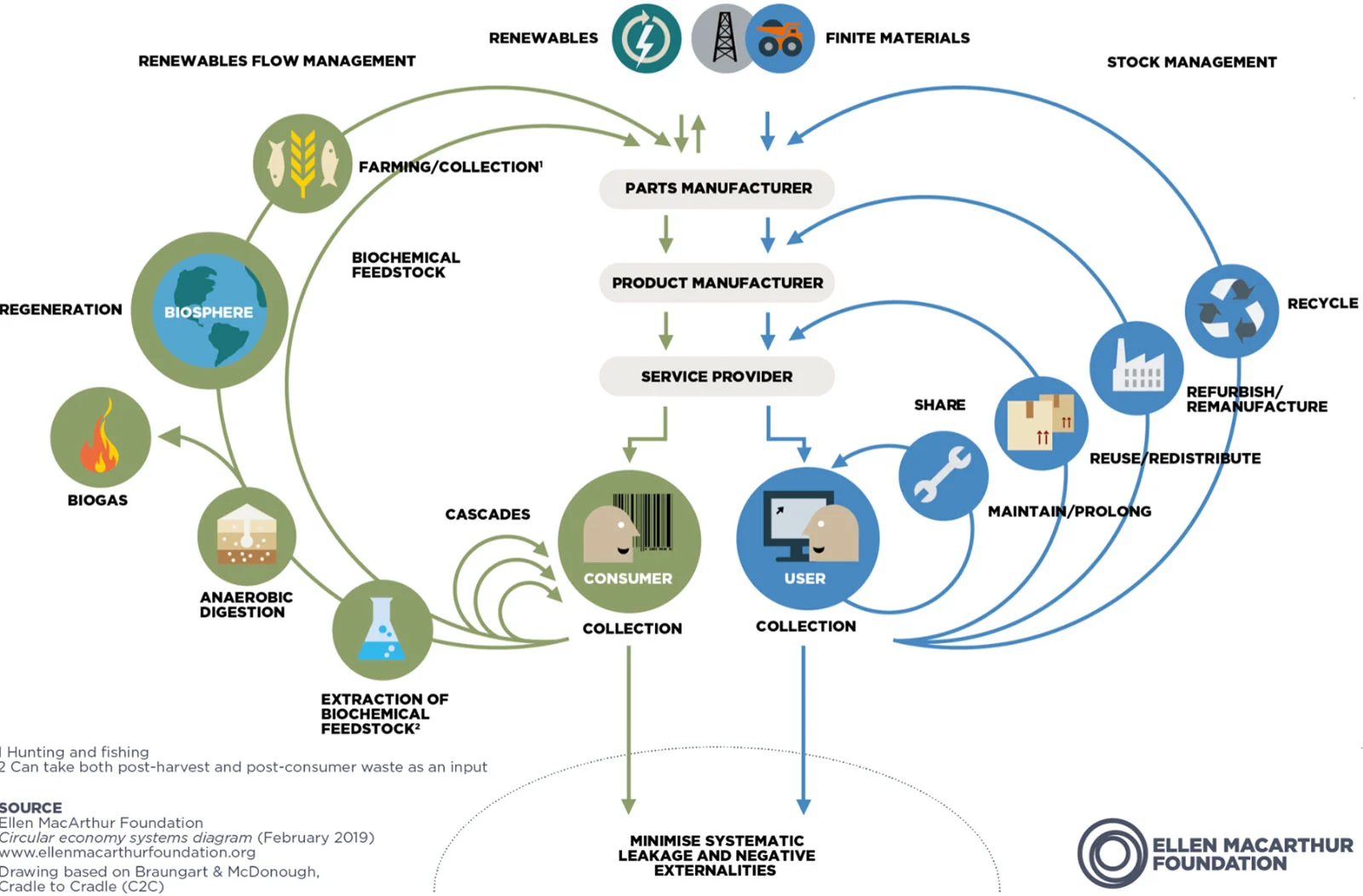
The Ellen MacArthur Foundation (EMF) provides a more radical model focused on changing the entire system and building a circular economy.
Its three core principles:
- Eliminate waste and pollution
- Circulate products and materials at their highest value
- Regenerate nature
For retailers, the most influential part of the EMF framework is its “Three Actions for Plastic,” which has been adopted by over 1,000 organizations:
EMF’s 3 Actions for Plastic
- Eliminate: Remove all problematic and unnecessary plastic items
- Innovate: Ensure all necessary plastics are 100% reusable, recyclable, or compostable
- Circulate: Keep all plastic items in the economy and out of the environment
The Butterfly Diagram
This model separates the technical cycle from the biological cycle in a circular economy.
Deploying SPC and EMF Frameworks in Tandem
Retailers must operate on both tracks simultaneously.
- The SPC framework provides a life-cycle optimization framework for managing immediate costs and compliance.
The EMF framework provides a radical redesign framework to guide R&D and long-term investment in new business models for a circular economy.

Navigating Regulations for Sustainable Packaging
Non-negotiable legal frameworks and labeling restrictions now represent the single greatest financial risk and operational challenge.
Below provides an in-depth look at the regulatory landscape for 2026.
Minimum Recycled Content (MRC) Mandates
These laws require manufacturers to use a minimum percentage of recycled material in sustainable packaging.
This material is most often post-consumer recycled (PCR) content, which is material that has been used by a consumer, collected, and reprocessed.
These laws typically target plastic beverage containers, trash bags, and paper shopping bags.
In many states, retailers and distributors can be held liable for selling non-compliant products.
Companies must identify which packaging products fall under MRC state laws and require manufacturers to provide a Certificate of Compliance (COC).
Packaging Material & Format Bans
These state or local laws completely ban the sale or distribution of single-use items.
A notable example is California’s Plastic Bag Ban, with many other states following the same path, including:
- Colorado
- Connecticut
- Delaware
- Hawaii
- Maine
- New Jersey
- New York
- Oregon
- Rhode Island
- Vermont
- Washington
Chemical & Material Health Restrictions
These laws focus on public health by banning hazardous chemicals from being used in sustainable packaging, especially if it touches food.
The most widespread example is the ban on polyfluoroalkyl substances (PFAs).
These “forever chemicals” are often used to make paper packaging resistant to grease and water.
This is a critical supply chain risk, as these chemicals are not visible.
Extended Producer Responsibility (EPR)
EPR is a policy approach that makes producers financially and operationally responsible for the end-of-life management of their sustainable packaging.
Producers are defined as brand owners, importers, and in many cases, retailers.
As of late 2025, seven states have enacted packaging EPR laws:
- California
- Colorado
- Maine
- Maryland
- Minnesota
- Oregon
- Washington
Eleven additional states have introduced similar legislation.
Most states require producers to join a “Producer Responsibility Organization” (PRO).
This is a non-profit entity that manages compliance for all its producer members, creates a statewide plan, collects fees, and organizes the recycling system.
The Circular Action Alliance (CAA), founded by major CPGs and retailers, has been approved as the sole PRO in Colorado, California, Minnesota, and Maryland.
EPR is not a flat tax.
The fees producers pay to the PRO will be modulated based on the sustainability of the packaging.
- Easy to recycle = lower fee
- Difficult to recycle = higher fee
Imminent Deadlines: Sales restrictions will be enforced on producers who are not compliant with registration and reporting.
US State EPR Compliance Calendar (2025–2029)
| State | Law Type | Approved PRO | Key Deadlines | Sales Ban for Non-Compliance |
|---|---|---|---|---|
| Oregon | PRO Model | CAA (Intends to be) | Must be a member of a PRO | July 1, 2025 |
| Colorado | PRO Model | Circular Action Alliance (CAA) | 2024 data report due July 31, 2025 | July 1, 2025 |
| Minnesota | PRO Model | Circular Action Alliance (CAA) | Must join a registered PRO by July 1, 2025 | January 1, 2029 |
| California | PRO Model | Circular Action Alliance (CAA) | Producer reports due November 15, 2025 | January 1, 2027 |
| Washington | PRO Model | TBD | N/A (Law passed May 2025) | March 1, 2029 |
| Maine | Stewardship Model | TBD | N/A (Amended 2025) | No statutory sales ban date |
| Maryland | PRO Model | Circular Action Alliance (CAA) | N/A (Law passed 2025) | No statutory sales ban date |
Federal Trade Commission (FTC) Truth-in-Labeling Regulations
The Federal Trade Commission’s (FTC) “Green Guides” are the primary US standard for eco-friendly claims on sustainable packaging.
They state that any claim must be truthful, specific, and substantiated.
- “Recyclable” Claim: Companies cannot call a package “recyclable” just because it is technically possible to recycle. This label can only be claimed if recycling facilities for that specific item are available to at least 60% of the consumers where the product is sold.
- “Compostable” Claim: Companies must be able to prove the item will break down safely in a composting facility.
- “Eco-friendly” or “Green”: These vague claims are considered deceptive by the FTC because they are impossible to substantiate.
These are federal-level rules designed to prevent “greenwashing,” or deceptive environmental marketing.
California SB 343: The Crackdown on "Chasing Arrows"
The Federal Trade Commission’s (FTC) “Green Guides” are the primary US standard for eco-friendly claims on sustainable packaging.
They state that any claim must be truthful, specific, and substantiated.
- “Recyclable” Claim: Companies cannot call a package “recyclable” just because it is technically possible to recycle. This label can only be claimed if recycling facilities for that specific item are available to at least 60% of the consumers where the product is sold.
- “Compostable” Claim: Companies must be able to prove the item will break down safely in a composting facility.
- “Eco-friendly” or “Green”: These vague claims are considered deceptive by the FTC because they are impossible to substantiate.
These are federal-level rules designed to prevent “greenwashing,” or deceptive environmental marketing.
The How2Recycle Recalibration
The How2Recycle label, run by the Sustainable Packaging Coalition, is the most common on-pack instructional label in the US.
In response to SB 343 and new data on recycling realities, How2Recycle announced major changes effective July 31, 2025.
Many items previously labeled “Widely Recyclable” are being downgraded.
This downgrade is a clear signal from the nation’s leading labeling body that the public infrastructure does not support these materials at scale.
Forest Stewardship Council (FSC) Labels
This is the “gold standard” for paper and fiber packaging.
It is a sourcing certification, not a recyclability claim.
Brands must ensure their suppliers have a “Chain of Custody” certification to legally use the FSC labels.
These are the different types of FSC certifications:
- FSC 100%: All materials are from FSC-certified, responsibly managed forests.
- FSC Recycled: The product is made from 100% recycled materials.
- FSC Mix: A combination of FSC-certified, recycled, and/or “controlled wood.”
Global Recycled Standard (GRS) Certification
The Global Recycled Standard (GRS) is an international certification that verifies recycled content in products and tracks it through every stage of the supply chain.
It ensures traceability, responsible production practices, and verified percentages of recycled content.
Below are the two different types of GRS certifications.
Common Product Labels
- GRS 100%: Made exclusively from certified recycled material
- GRS Blended: Mixture of recycled and non-recycled content, with clear percentage labeling
Biodegradable Products Institute (BPI) Labels
This is one of the most misused and misunderstood labels.
The organization, BPI, verifies that a sustainable packaging product meets ASTM standards for compostability.
This certification is almost exclusively for industrial or commercial composting facilities.
It does not mean “home compostable.
That is a separate BPI certification.
The vast majority of US consumers lack access to industrial composting.
Labeling a product “compostable” with the BPI logo in a region without this infrastructure is a major “greenwashing” risk and a primary source of contamination in recycling streams.

Procurement Strategies for Sustainable Packaging
Knowing the regulations is the first step.
The next step is putting that knowledge into action.
An effective procurement strategy for sustainable packaging must shift from focusing on unit price to managing total cost, regulatory risk, and logistics.
Successfully sourcing compliant packaging requires a new playbook.
Here are the strategies to implement.
Strategy 1: Shift from Sourcing to Strategic Partnership
The old model of bidding out multiple suppliers for the lowest unit price is risky, costly, and time-consuming.
The regulatory risk is too high, and the compliance data is too complex.
Brands should consolidate packaging spend with one strategic partner.
This partner takes on the burden of expertise, including:
- Managing compliance
- Tracking regulatory changes
- Providing data for your EPR reports
- Sourcing innovative materials
Don’t navigate this risk alone. The landscape is complex, but your next step is simple. Schedule a free strategy call with the experts at Creative Retail Packaging today.
Strategy 2: Revise Your RFQ for Compliance
Most companies use a Request for Quote (RFQ) as the primary tool for filtering suppliers.
To ensure compliance, this document must be updated to include new requirements.
- Provide Chain of Custody: For all fiber-based products, suppliers must provide their FSC “Chain of Custody” certification.
- Guarantee Compliance: Suppliers must contractually warrant that their products are compliant with all state-level chemical bans.
Deliver EPR Data: The supplier must agree to provide all necessary data for your EPR filings, including exact material types, package weights, and recycled content percentages.
Strategy 3: Implement a Sustainable Supplier Scorecard
Companies cannot manage what they do not measure.
An internal supplier scorecard, used to evaluate who gets your business, must be updated.
Example of Packaging Supplier Scorecard
| Criteria | Metric | Weight | Supplier A (Score 1-5) | Supplier A (Weighted Score) | Supplier B (Score 1-5) | Supplier B (Weighted Score) |
|---|---|---|---|---|---|---|
| Financials (TCO) | Total Cost of Ownership (Unit Price + Freight + Waste + Labor Impact) | 40% | 5 | 2 | 3 | 1.2 |
| Transparency & Data | Speed, accuracy, and completeness of data for EPR reporting, COCs, and audits | 25% | 2 | 0.5 | 5 | 1.25 |
| Innovation & Optimization | Proactively suggests “right-sizing,” new materials, or designs to lower TCO | 20% | 2 | 0.4 | 4 | 0.8 |
| Supply Chain & Logistics | Geographical diversification, lead times, and inventory management programs | 15% | 3 | 0.45 | 4 | 0.6 |
| TOTAL | 100% | 3.35 | 3.85 |
Example Analysis:
- Supplier A is cheaper on a TCO basis, but poses a significant data management risk and is not innovative.
- Supplier B has a slightly higher total cost but offers far superior transparency, innovation, and logistical security, making them the stronger strategic partner.
Strategy 4: Build a Resilient Supply Chain
Volatility in the supply of sustainable materials is a known risk.
However, brands must also mitigate risks associated with logistical bottlenecks and geographical concentration.
Relying on a single manufacturing region or logistics hub, even with a strategic partner, reintroduces the vulnerability that procurement teams are trying to escape.
A truly resilient supply chain strategy involves building a redundant and flexible logistics network.
Geographical Diversification
Brands should work with strategic partners who have production facilities in multiple regions.
This mitigates risks from regional shutdowns, port delays, packaging tariffs, and natural disasters.
Logistical Redundancy
The procurement strategy should pre-qualify factories, not just suppliers.
If one factory has a machine failure, production volume should shift to an already-approved backup facility without interrupting the supply chain.
Inventory Management
Companies can hold brand-specific inventory in multiple locations, placing it closer to the brand’s key distribution centers.
This practice cuts freight costs and lead times, ensuring business continuity.

Decoding Consumer Perception vs. Reality for Sustainable Packaging
This analysis of consumer data reveals a critical gap between what consumers say they want, what they actually do, and what they perceive as sustainable.
The "Say-Do" Gap
There is no shortage of data showing consumer aspirations.
Studies show 90% of consumers are more likely to buy from brands with sustainable packaging, and 74% claim they are willing to pay more for it.
However, real-world purchasing data from McKinsey’s 2025 global survey tells a different story: Price and quality dominate.
When making an actual purchase, consumers consistently rank product quality, price, and convenience as more important than environmental impact.
Consumer willingness to pay a premium for sustainability declined between 2020 and 2023, influenced by global inflation and cost-of-living pressures.
While the absolute number of consumers who care about the environment has remained steady, with 51% ranking it “very important”, they are simply focusing more on price when making their final decision.
The Brand Loyalty Dividend
Despite the “Say-Do” gap, sustainability is a powerful driver of brand loyalty and differentiation, especially among Millennial and Gen Z demographics.
The financial value in sustainable packaging is not in a price premium but in customer retention.
A critical 39% of consumers report they have switched brands because a competitor offered sustainable packaging.
Calculating the ROI of Sustainable Packaging
Many leaders see sustainable packaging as a “cost,” but this is a mistake.
The financial framework for decision-making should move sustainable packaging from a line item expense to a strategic driver of value.
When calculated correctly, sustainable packaging is an investment with a clear and compelling return.
Here is the strategic formula to use:
Strategic Value Formula for Sustainable Packaging
Total ROI = (Net Operational Savings + Strategic Risk Mitigation + Brand Loyalty Lift) – (One-Time Investment Cost)
NOTE: This is not a formal accounting ratio. It is a strategic financial model designed to show the full value created by sustainable packaging.
Here is a practical guide for each part of that equation.
Component 1 | Total Investment Cost
This is the full cost required to launch or transition to a sustainable packaging program.
It typically includes:
- Design and engineering
- Tooling or mold creation
- Certifications and compliance setup
- Changeover costs
- Initial implementation
- Program management
Many packaging partners offer fully managed programs that simplify implementation.
Component 2 | Net Operational Savings
This captures the recurring annual savings from moving to a sustainable packaging system.
To quantify it, compare the Total Cost of Ownership (TCO) of your current packaging to the TCO of the new system.
TCO Inputs Explained
- Purchase Price: Per-unit cost of packaging materials.
- Freight Costs: Lighter or right-sized packaging reduces shipping costs.
- Labor Costs: Streamlined designs shorten assembly and packing time.
- Waste Disposal Fees: Reduced material means lower disposal volume and cost.
- Damage/Return Costs: Better protection reduces replacements, credits, and labor.
Step 1: Calculate Current TCO (Old System)
Current TCO = Old Purchase Price + Old Freight + Old Labor + Old Disposal Fees + Old Damage/Return Costs
Step 2: Calculate Projected TCO (New System)
Projected TCO = New Purchase Price + New Freight + New Labor + New Disposal Fees + New Damage/Return Costs
Step 3: Calculate Annual Operational Savings
Net Operational Savings = Current TCO – Projected TCO
All recurring program expenses should be included on the “new system” side to maintain accuracy.
Component 3 | Strategic Risk Reduction
This represents the financial value of lowering exposure to regulatory penalties, recalls, compliance failures, or reputational damage.
Quantify each major risk using an expected-value approach:
Step 1: Estimate Expected Cost (Old System)
Old Expected Cost = Old Probability x Impact
Step 2: Estimate Expected Cost (New System)
New Expected Cost = New Probability x Impact
Step 3: Calculate Risk Reduction Value
Risk Reduction Value = Old Expected Cost – New Expected Cost
Sum the values across the risks most relevant to your business.
This produces a dollar-based estimate of the financial protection generated by sustainable packaging.
Component 4 | Brand Loyalty Lift
Sustainable packaging influences perception, loyalty, and long-term customer value.
This component measures the incremental revenue and margin associated with the new sustainable packaging.
What to Measure
- Repeat Purchase Rate: Compare repeat behavior between customers exposed to the new packaging and those using the old version.
- Customer Lifetime Value (CLV): Track the difference in CLV between pre-launch and post-launch customer cohorts, or through structured A/B testing.
- Incremental Margin: Convert any uplift in repeat purchases or CLV into incremental gross margin—not just revenue.
- Engagement Indicators: Social mentions, UGC, and positive reviews support the analysis and help validate the source of the lift.
The result is a quantifiable revenue and margin increase attributable specifically to the change to sustainable packaging.
Scale Sustainable Packaging Without Disruption or Overspend

The conversation must now shift from “How much will this cost?” to “How much will this save us?”
Creative Retail Packaging helps brands move from outdated packaging systems to sustainable programs that drive measurable business value.
We optimize across processes, materials, accessibility, waste reduction, and life-cycle impact.
Through supply chain analysis, vendor alignment, and creative prototyping, we enable brands to:
- Lower total packaging costs through material optimization and operational efficiency.
- Increase consumer loyalty by aligning sustainability with brand storytelling and usability.
- Reduce regulatory risk through compliant, recyclable, or reusable packaging systems.
- Integrate circularity with scalable solutions that fit existing manufacturing and logistics.
Build a long-term packaging strategy that is profitable, compliant, and future-ready with our team of experts.
Need more information? Read our blog: The Benefits of Working With a Strategic Packaging Company..